Softbox vs. Umbrella for Small Product Photo Sessions (and Which to Buy First)
If you’ve ever been lost in the lighting aisle wondering whether a softbox or umbrella will make your photos look more professional, you’re not alone. Both modifiers soften and spread light, but they behave very differently in a tabletop or small-studio environment.
The truth is, neither is “better.” The question isn’t ‘which is best overall’, it’s ‘which is best for how you create images, how much space you have, and the kind of look you want.’
By the end of this article, you’ll know exactly how each modifier affects light quality, where they shine (pun intended), and which one you should buy first.
What Softboxes and Umbrellas Actually Do
Softboxes and umbrellas exist for one reason: to turn harsh, pinpoint light into something wide and flattering.
They do this by increasing the apparent size of your light source and diffusing it before it hits your subject.
Where they differ is in control.
- A softbox funnels the light in a specific direction.
- An umbrella sprays it everywhere.
That difference affects everything — contrast, shadows, reflections, and even how much light bounces off your walls.
The Softbox — Controlled, Polished Light
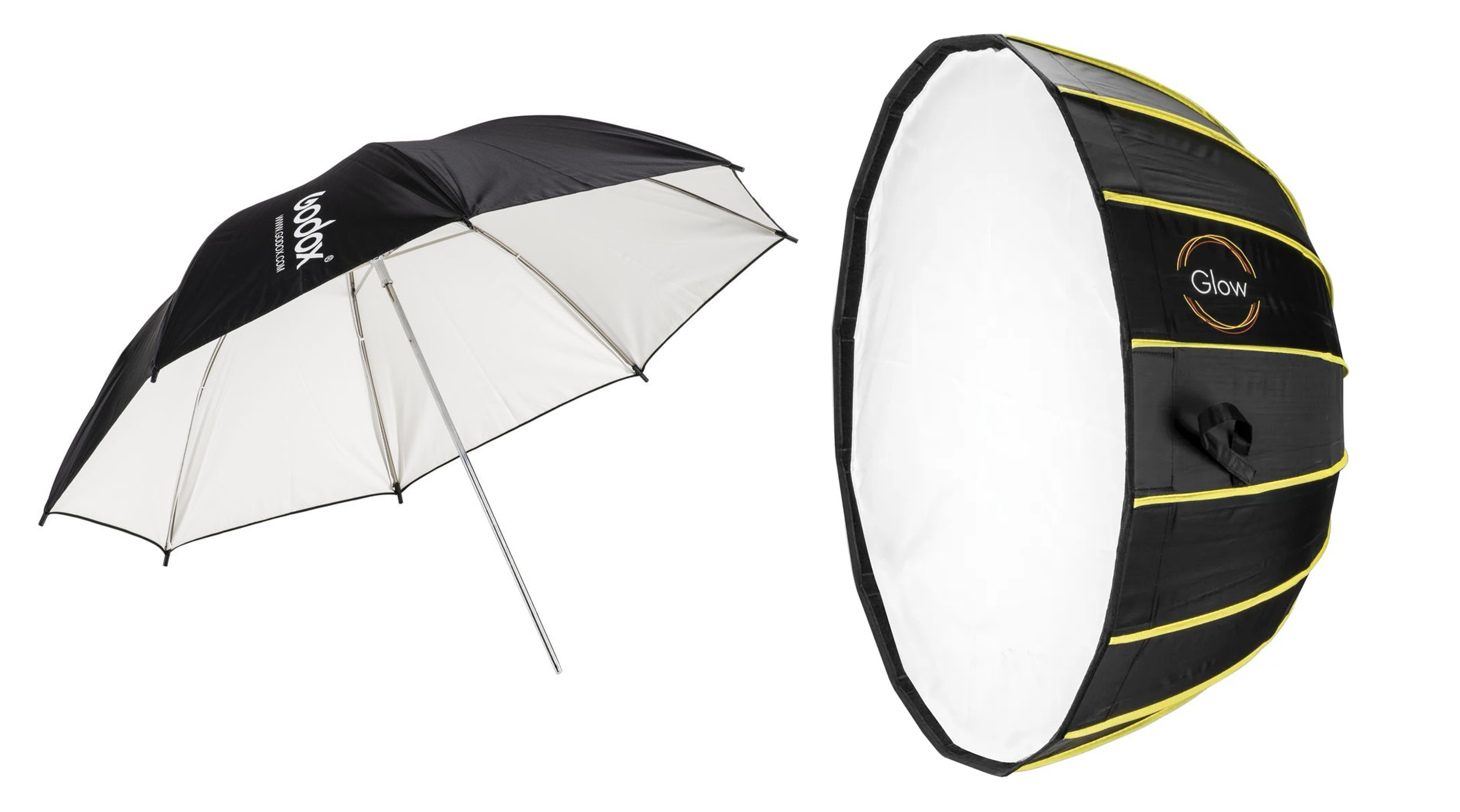
A softbox is basically a fabric box with a white diffusion panel on the front.
The light goes in one side, bounces around inside the silver walls, and exits through the front — giving you even, directional light with soft edges.
In product photography, that control matters a lot.
You can decide exactly where the light hits, where it fades, and what stays in shadow.
Softboxes excel when:
- You need to contain light-spill and keep your backgrounds dark.
- You’re working with shiny surfaces (bottles, cans, glassware).
- You want consistent results for a series of shots (menus, catalogs).
They’re also ideal if you’re using strobes like the Godox AD600 Pro or Flashpoint EXPLOR 300 Pro — the front diffusion panel helps create that beautiful gradient highlight across reflective packaging.
A softbox takes a bit longer to set up than an umbrella, but what you get in return is repeatability. You can dial in a look, mark your distances, and recreate it any time.
Example images: two identical products — one lit bare, one lit through a softbox — to show the smoother fall-off and gentler shadows.
The Umbrella — Fast, Wide, and Forgiving
Umbrellas are the quick-and-easy cousins of softboxes. Pop one open, point your light at it, and you’ve got instant diffusion.
There are two main types:
- Shoot-through umbrellas: the light passes through the fabric, scattering widely.
- Reflective umbrellas: the light bounces off the inside surface and back toward the subject.
Umbrellas are known for their broad, forgiving light. They fill a space fast and give you that soft, airy look many lifestyle photographers love.
They’re also cheap and portable — perfect for on-location sessions at restaurants or cafés where setup time and space are limited.
But that wide spread can be a liability in a small studio.
Light bounces off nearby walls, the ceiling, even the floor — lowering contrast and washing out your shadows.
If you’re photographing glossy products, all that uncontrolled spill can create weird highlights or double reflections.
Example image: same product lit with an umbrella, showing how it lights the background and reduces contrast.
When to Choose a Softbox
If your style leans toward consistent, controlled, and directionally shaped light, a softbox should be your first buy.
Go for a softbox when:
- You photograph glossy, reflective, or metallic products.
- You want to create controlled highlights and clean edge lighting.
- Your space is small and you can’t afford light bouncing everywhere.
- You plan to build lighting recipes you can repeat for clients.
Softboxes also make it easier to use flags and grids to shape light even further. You can block one side, narrow the beam, or keep the background dark — all things that are nearly impossible with umbrellas.
If you’ve got a light like the Godox SL-60W or AD600 Pro, pairing it with a 24×24” or 60×60cm softbox gives you a rock-solid starting point for almost any tabletop subject.
When an Umbrella Makes More Sense
If your goal is speed, simplicity, or atmosphere, an umbrella might be your best friend.
They shine when:
- You’re taking pictures of food on location or need fast setup/teardown.
- You’re going for bright, natural, “daylight” looks.
- You’re photographing matte subjects — baked goods, fabric, rustic wood.
- You need lots of light coverage for flat lays or large compositions.
Umbrellas are also beginner-friendly. There’s no wrong way to aim one — and because they’re cheap, you can experiment without fear of breaking expensive modifiers.
Common Misconceptions
|
Myth |
Reality |
|
“Umbrellas are only for portraits” |
Not true. They’re great for overhead fills or wide flat-lay lighting. |
|
“Softboxes always look better” |
Depends on the subject. Umbrellas create a beautiful open look for lifestyle or social media imagery. |
|
“Umbrellas can’t be controlled” |
You can control spill with black-backed models or feathering (turning the umbrella slightly off-axis). |
Testing the Difference (Try This Yourself)
Set up a simple test to see the difference:
- Mount your light in the same position for both modifiers.
- Place a product (like a shiny mug or soda can) about 3 feet away.
- Keep exposure settings identical.
- Take one shot with the umbrella and one with the softbox.
Compare:
- Shadow edge: Softer, more gradual with the umbrella.
- Highlight shape: More defined and cleaner with the softbox.
- Background: Brighter and lower contrast with the umbrella.
Once you see those differences side by side, the “which to buy first” question almost answers itself.
So Which Should You Buy First?
Here’s the simple truth:
- If you capture mostly tabletop, food, or shiny objects: Start with a softbox. You’ll love the control.
- If you photograph larger scenes or need quick setups on the go: Grab an umbrella first. It’s forgiving, fast, and cheap.
Eventually, you’ll want both — and you’ll use them interchangeably depending on the mood and the space.
Recommended Starter Gear
Softboxes
Umbrellas
Accessories
As an Amazon Associate I earn from qualifying purchases.
Final Thoughts
The best lighting modifier isn’t defined by brand or price — it’s defined by how much control it gives you over the light.
Softboxes give you surgical precision. Umbrellas give you freedom and speed.
Both can produce gorgeous images when used intentionally.
Start with one. Learn how the light behaves. Move it closer, farther, higher, lower.
Once you can predict what it’ll do before you click the shutter, you’ve graduated from “using light” to sculpting light — and that’s where the magic really starts.
Next up: “How Distance Changes Softness — The Inverse Square Law for Photographers.”